
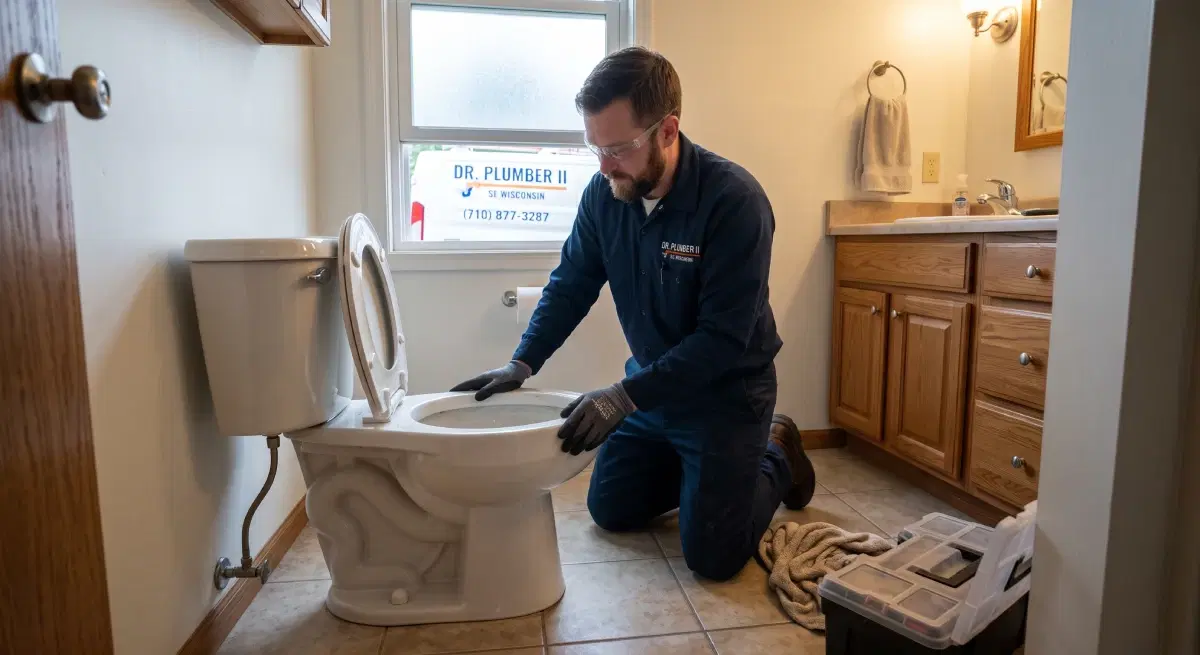

A clogged toilet never picks a convenient time. It’s the morning of a family gathering, the night before an early flight, or the only bathroom in the house.
For Southeastern Wisconsin homeowners, the cost to unclog a toilet ranges from almost nothing, if a plunger does the job, to roughly $100 to $300 for a typical professional service call. Clogs that require pulling the toilet, clearing a foreign object, or cleaning the main sewer line can cost considerably more.
The real question isn’t just what a plumber charges. It’s where the clog is and what’s causing it.
Here’s what Oak Creek and Southeastern Wisconsin homeowners should know before they pick up the plunger or the phone.
For budgeting purposes, most toilet clogs fall into one of these categories:
| Situation | Estimated Cost | What Can Affect the Price |
|---|---|---|
| DIY with a plunger or toilet auger | $0–60 | Whether you already own a flange plunger or closet auger |
| Standard professional clog removal | $100–300 | Service call fee, severity of the clog, time on site |
| After-hours or emergency service | $200–450+ | Nights, weekends, holidays, urgency |
| Pulling the toilet to remove an object | $200–450 | Object type, new wax ring and hardware, toilet condition |
| Main line or sewer clog causing toilet backup | $250–700+ | Cleanout access, line length, tree roots, camera inspection, hydro jetting |
These figures are planning ranges, not flat-rate quotes. A plumber needs to see what’s going on before pricing the job.
Most toilet clogs are close to the bowl and clear quickly. Clogs deeper in the drain system are a different project.
Several factors can move your final price up or down.
A clog in the toilet’s built-in trap is usually the simplest and least expensive fix. A plumber can often clear it with a professional closet auger in a short visit.
If the blockage is farther down the drain line, or in the main sewer line that serves the whole house, the job takes more equipment and more time.
Too much toilet paper usually breaks up with the right tool. Other culprits are harder to clear:
A solid object lodged in the trap may not come out with an auger. In that case, the toilet may need to be removed, cleared, and reset with a new wax ring.
A clog on a Tuesday afternoon usually costs less than one at 11 p.m. on a Saturday. After-hours and emergency service often carries a higher rate. If your home has a second working toilet, waiting for regular business hours can save money.
Pulling a toilet involves shutting off the water, disconnecting the supply line, lifting the fixture, clearing the blockage, and resetting it with a fresh seal. That added labor and material is the main reason some clogs cost more than others.
If the toilet is only a symptom of a bigger blockage, the plumber may need to clean the main line through a cleanout. A camera inspection may also be recommended to find out why the line keeps clogging.
This is the difference between a quick fix and a bigger job, and there are a few clues to watch for.
A problem is probably limited to the toilet if:
A problem may be in the main line if:
If multiple drains are affected, stop flushing and running water until the problem is diagnosed.
Many older homes across Southeastern Wisconsin have original cast iron or clay sewer piping. Over time, that pipe can develop scale, cracks, or offset joints, and tree roots can work their way into the line. Those conditions give toilet paper and debris something to catch on.
If your toilet clogs repeatedly, the cause may not be the toilet at all. A camera inspection can show whether roots, pipe damage, or buildup in the line is to blame, so you’re not paying for the same clog again and again.
Older low-flow toilets can also contribute. Some early models don’t move waste as effectively as modern designs, and replacing a problem toilet is sometimes more cost-effective than repeated service calls.
For a simple clog, a few steps are worth trying before calling a plumber:
Avoid chemical drain cleaners in toilets. They often don’t work on toilet clogs, can damage older pipes and seals, and create a hazard for anyone who has to work on the toilet afterward.
If a few attempts don’t clear it, it’s time to call a professional. Forcing it can crack the bowl or push the blockage deeper.
Call a professional if:
A plumber can clear the clog, confirm whether the problem is isolated to the toilet, and let you know if repairs or a line cleaning are needed.
Yes, and most of it comes down to prevention and timing.
When comparing quotes, make sure you’re comparing the same scope of work. A low price for clearing the toilet won’t help if the real problem is in the main line.
For most Southeastern Wisconsin homeowners, the cost to unclog a toilet professionally falls somewhere around $100 to $300. Jobs that require removing the toilet, after-hours service, or clearing the main sewer line can run several hundred dollars more.
The only reliable way to know what your situation requires is to have a plumber take a look.
Dr. Plumber II provides clog removal, toilet repair in Oak Creek, and drain cleaning throughout Southeastern Wisconsin, including Franklin, South Milwaukee, Cudahy, Greenfield, Greendale, Muskego, Caledonia, and surrounding communities. Our licensed, bonded, and insured plumbers can clear the clog, find the cause, and recommend a fix that keeps it from coming back. We also offer 24-hour emergency service, 7 days a week.
Don’t let a stubborn clog turn into an overflow.
Toilet backed up or clogging again? Call Dr. Plumber II at (414) 698-4528 to schedule a service call.